
“The Starved Brain”: What Happens When the Mind Runs on Too Little Fuel?

When we think about starvation, we tend to picture the body: weight loss, weakness, feeling cold, a slowing heart. But starvation also happens in the brain.
And that matters, because some of the most confusing features of prolonged undernutrition—difficulty concentrating, rigid thinking, irritability, anxiety, social withdrawal, and an intense preoccupation with food—may not simply reflect personality or willpower. They can emerge, or become substantially worse, when the brain is chronically undernourished. The brain adapts—but adaptation has a cost
The human brain is remarkably good at surviving periods of food scarcity. When energy availability falls, the body changes its metabolism and hormonal signaling to conserve resources and keep essential systems functioning. But “still functioning” is not the same as “functioning normally.”
Research examining starvation and malnutrition in humans has associated inadequate nutrition with cognitive difficulties as well as changes in mood, anxiety, sleep, social behavior, and emotional regulation. In other words, when the body is starved, thinking itself can change.
The paradox of starvation
One of the strangest effects is that eating less can make the mind think more about food. People experiencing prolonged restriction may find themselves reading recipes, planning meals, watching cooking videos, calculating nutrients, studying restaurant menus, or thinking repeatedly about what they will—or will not—eat.
From the outside, that can look contradictory. It isn’t. A brain confronted with scarcity has every reason to make food increasingly salient. Hunger is not simply an uncomfortable sensation in the stomach. It is a powerful biological signal designed to alter attention and behavior.
At the same time, starvation-related changes can coexist with anxiety, obsessive thinking, cognitive rigidity, and difficulty making decisions. The result can be a cruel loop: the brain becomes increasingly focused on food while eating can become increasingly frightening or difficult.
Starvation can change the brain physically, too. This is not purely psychological. Large neuroimaging studies of people who are acutely underweight with anorexia nervosa have found widespread reductions in measures such as cortical thickness and subcortical brain volume. For example, in the image below the patient with an eating disorder has lots of black spaces (where white matter has been lost). In the healthy person the brain is full with no gaps.
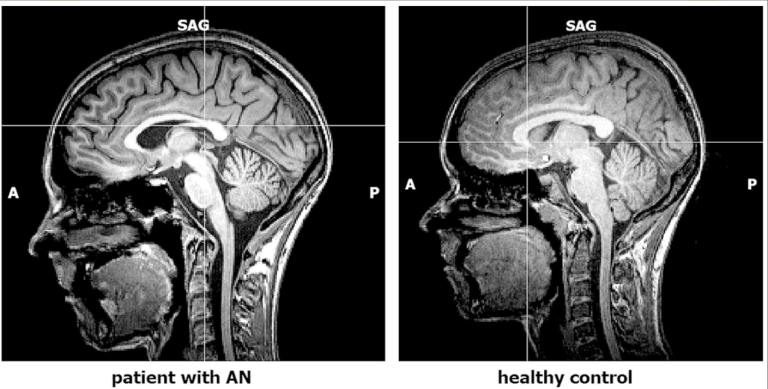 [Seitz, Buehren, von Polier, & Konrad, 2014]
That sounds alarming—and it deserves to be taken seriously. But there is another important part of the story: many of these differences become substantially less pronounced with nutritional rehabilitation and weight restoration. Studies following patients over time have demonstrated substantial and, in some studies, relatively rapid structural recovery as nutrition improves.
The starved brain is therefore not necessarily a permanently damaged brain. It is a brain under extraordinary physiological stress.
Why “Just think differently!” can fail
This helps explain a frustrating phenomenon in eating-disorder treatment. A person may intellectually understand that they need nourishment. They may genuinely want their life back. They may recognize that their eating-disorder rules are irrational. And yet they can still feel unable to act against them.
That doesn’t mean psychological treatment is unimportant. It means psychotherapy is being asked to work inside a biological system whose functioning has been altered by inadequate nutrition. Nutritional rehabilitation and psychological recovery therefore aren’t competing approaches. They interact. Sometimes the brain needs more fuel in order to become more flexible, more emotionally regulated, and more capable of doing the difficult cognitive work that recovery requires.
You cannot judge malnutrition by appearance alone
There is another misconception worth dismantling: that someone must “look emaciated” before inadequate nutrition can seriously affect them. Restrictive eating disorders can occur across all body sizes & shapes. Emerging neuroimaging research has found brain differences in people with atypical anorexia nervosa as well as those with anorexia nervosa. A person’s appearance alone is a poor indicator of how medically or psychologically affected they may be.
The hopeful part: brains respond to nourishment
Perhaps the most important message from the neuroscience is not that starvation changes the brain. It is that nutrition changes it, too. Research following people through nutritional rehabilitation shows that at least some structural brain abnormalities improve considerably with weight restoration. Cognitive performance can improve during treatment as well.
Recovery is rarely instantaneous. The mind may lag behind the meal plan. Fear may persist after eating increases. Thoughts can remain rigid even while the body begins repairing itself. But nourishment is not merely about restoring weight. It is part of restoring the biological conditions in which a brain can think, learn, regulate emotion, connect with other people—and recover.
So when someone struggling with severe restriction says:
“I don’t feel like myself anymore.”
There may be considerable truth in that statement.
The person is still there. But their brain may be trying to operate under conditions it was never meant to sustain. Sometimes one of the most powerful interventions for the mind begins with something deceptively ordinary: feeding the brain.
________________________________________________________________________________________________________________________________________________________________
EVIDENCE
Spettigue W, et al. The Psychological, Cognitive, and Behavioural Effects of Starvation in Humans: A Scoping Review. European Eating Disorders Review. 2025. The review synthesized 318 studies and identified cognitive, psychological, emotional, and behavioral consequences of starvation and malnutrition.
Hebebrand J, et al. The role of hypoleptinemia in the psychological and behavioral adaptation to starvation: Implications for anorexia nervosa. Neuroscience & Biobehavioral Reviews. 2022. Reviews neuroendocrine adaptations to starvation and their potential relationships with cognition, emotion, reward, and food-related behavior.
Walton E, et al. Brain Structure in Acutely Underweight and Partially Weight-Restored Individuals With Anorexia Nervosa: A Coordinated Analysis by the ENIGMA Eating Disorders Working Group. Biological Psychiatry. 2022. This multicenter analysis found widespread reductions in cortical thickness and subcortical volumes in acute anorexia nervosa, with less pronounced differences in partially weight-restored patients.
Bahnsen K, et al. Dynamic Structural Brain Changes in Anorexia Nervosa: A Replication Study, Mega-analysis, and Virtual Histology Approach. Journal of the American Academy of Child & Adolescent Psychiatry. 2022. Structural abnormalities increased toward normal during partial weight restoration, and recovered participants did not show the same differences from healthy controls.
Kaufmann L-K, et al. Age influences structural brain restoration during weight gain therapy in anorexia nervosa. Translational Psychiatry. 2020. Longitudinal imaging demonstrated recovery of cortical thickness and subcortical volumes during weight-restoration treatment.
Schnabel J, et al. Does cognitive functioning improve with weight restoration? An examination of changes in intelligence quotient scores in adolescents with anorexia nervosa before and after treatment. Eating Disorders. 2025. Cognitive measures improved over the course of treatment, although this should not be interpreted to mean that every cognitive effect of malnutrition is immediately or completely reversible.
Lyall AE, et al. Lower region-specific gray matter volume in females with atypical anorexia nervosa and anorexia nervosa. International Journal of Eating Disorders. 2024. Lower gray-matter volumes were identified in several cortical regions in both anorexia nervosa and atypical anorexia nervosa compared with healthy controls.
- European Eating Disorders ReviewWendy Spettigue, et al. 2025DOI: 10.1002/erv.3174URL: https://doi.org/10.1002/erv.3174
- Neuroscience & Biobehavioral ReviewsJohannes Hebebrand, et al. 2022DOI: 10.1016/j.neubiorev.2022.104807URL: https://doi.org/10.1016/j.neubiorev.2022.104807
- Biological PsychiatryEsther Walton, et al. 2022DOI: 10.1016/j.biopsych.2022.04.022URL: https://doi.org/10.1016/j.biopsych.2022.04.022
- Journal of the American Academy of Child & Adolescent PsychiatryKlaas Bahnsen, et al. 2022DOI: 10.1016/j.jaac.2022.03.026URL: https://doi.org/10.1016/j.jaac.2022.03.026
- Translational PsychiatryLisa‐Katrin Kaufmann, et al. 2020DOI: 10.1038/s41398-020-0809-7URL: https://doi.org/10.1038/s41398-020-0809-7
- Eating DisordersJiana Schnabel, et al. 2025DOI: 10.1080/10640266.2025.2552367URL: https://doi.org/10.1080/10640266.2025.2552367
- International Journal of Eating DisordersAmanda E. Lyall, et al. 2024DOI: 10.1002/eat.24168URL: https://doi.org/10.1002/eat.24168
- Seitz J, Bühren K, von Polier GG, Heussen N, Herpertz-Dahlmann B, Konrad K. Morphological changes in the brain of acutely ill and weight-recovered patients with anorexia nervosa. A meta-analysis and qualitative review. Z Kinder Jugendpsychiatr Psychother. 2014 Jan;42(1):7-17; quiz 17-8. doi: 10.1024/1422-4917/a000265. PMID: 24365959.
At a Glance
Dr. Sarah Lowenthal
- Board Certified Family Physician
- Voted Top Doctor 2026
- Expertise and Compassion
- Learn more